Carbon capture has a cost problem, and much of it comes down to heat.
On September 16, InnoTech Alberta launched a pilot at the Alberta Carbon Conversion Technology Centre (ACCTC) in Calgary that it says could cut carbon capture costs by up to 70 per cent by sharply lowering the energy needed to capture CO₂. The system is being tested on real industrial emissions: flue gas from the neighbouring Shepard Energy Centre, Alberta’s largest natural gas-fuelled power facility.
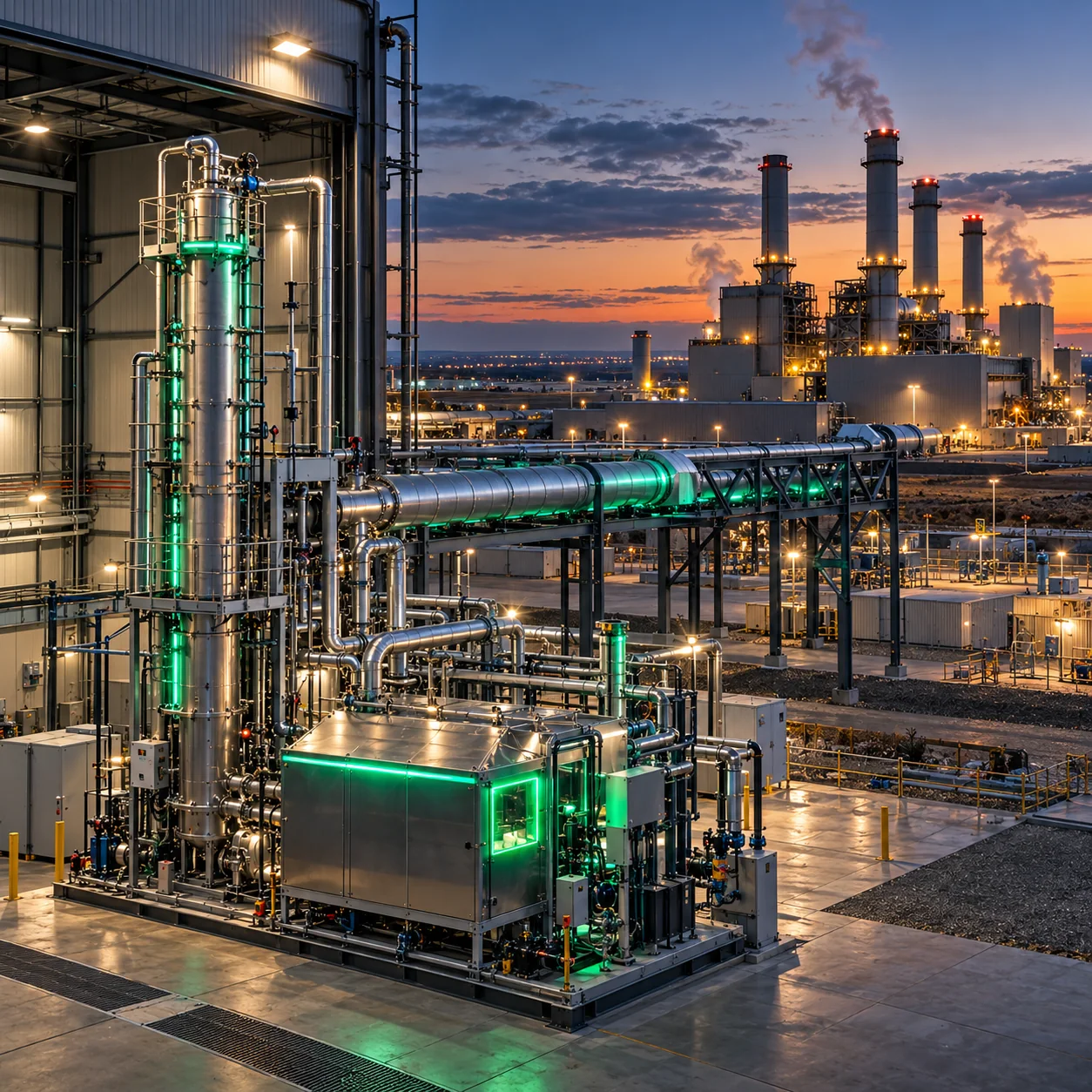
The unit itself is small, a modular microwave CO₂ stripper that processes one tonne of CO₂ per day. Its importance comes from what it targets. It goes after the energy-hungry step at the centre of conventional solvent-based capture instead of chasing another gain in scale.
Three Alberta Technologies in One Test Unit
According to InnoTech Alberta, the pilot combines three Alberta-developed innovations: a proprietary water-lean solvent, advanced packing materials and a novel microwave heating system that targets energy only where it is needed.
Each component works on a different part of the problem. Solvent chemistry determines how much energy it takes to release captured CO₂. Packing governs how well gas and liquid make contact inside a column. The heating method determines how efficiently that release energy reaches the solvent.
Improving any one of these can trim costs. The pilot is testing whether improving all three together can change the economics more fundamentally.
The pilot runs through December 2026 and is supported by the federal and provincial governments and industry partners, InnoTech Alberta says.
Energy Is the Number That Decides Capture Economics
Conventional amine capture works in two stages. A solvent absorbs CO₂ from the flue gas, then the solvent is heated, usually with steam, to strip the CO₂ out so the solvent can be reused. That regeneration step is a major operating cost, and at a power plant it draws energy away from the plant’s own output.
Microwave heating takes a different approach. Instead of heating a large volume of liquid with steam, it delivers energy more directly to where the separation happens. A water-lean solvent also reduces the amount of water that has to be heated along with the CO₂-rich solution.
That change matters.
Lower regeneration energy means a lower cost per tonne captured, smaller utility systems around the capture unit and fewer emissions from producing the heat in the first place. For emitters weighing whether to retrofit capture, those three factors often decide whether a project makes sense.
Real Flue Gas Is the Test That Counts
Many capture technologies look promising in the lab and struggle once they meet actual exhaust. Industrial flue gas brings impurities, fluctuating conditions and continuous operation that bench-scale work cannot fully reproduce.
The ACCTC was built to close that gap. The centre sits next to the Shepard Energy Centre, which is jointly owned by ENMAX and Capital Power, and pipes a portion of the plant’s flue gas directly into its testing bays. Its role is to prove capture and conversion technologies at intermediate scale before they are deployed at full-size facilities.
Testing the technology at pilot scale helps reduce risks associated with commercialization, according to Tom Whalen, senior vice president of applied research, engineering and specialized testing services at Alberta Innovates.
Two questions will define the result:
Do the energy savings hold up over months of operation on real gas?
And can a one-tonne-per-day unit point to a credible design at commercial scale?
Storage Hubs Are Being Built, So Capture Costs Now Matter More
The timing makes sense. On September 9, Enhance Energy broke ground on its Origins carbon capture and storage hub near Clive, Alberta. Origins is designed to initially store up to 1.5 million tonnes of CO₂ per year, and operations are expected to begin in January 2027. The hub is intended to serve cement, oil and gas, power generation, hydrogen and petrochemical facilities along the Edmonton to Calgary corridor.
Shared transport and storage capacity is starting to arrive in Alberta. The next constraint is the cost of capture at each individual emitter. A hub with available pore space only fills if the sources around it can capture CO₂ at a price that works under carbon pricing and federal incentives.
For developers and emitters following the pilot, the useful data points will be practical:
- Measured energy use per tonne compared with a conventional amine baseline
- Solvent stability and degradation over the full test period
- Reliability of the microwave hardware under continuous operation
- Electricity cost and grid emissions intensity of the microwave power supply
- Performance on dilute natural gas power plant flue gas
- A clear scale-up path beyond one tonne per day
The electricity question deserves particular attention. Microwave systems run on power instead of steam, so their overall benefit depends partly on the price and carbon intensity of the electricity behind them. In Alberta’s grid, that calculation will be specific to each site.
Alberta Is Building Technology to Match Its Infrastructure
Most of the attention on Canadian CCUS goes to large hubs and trunk lines. Pilots like this one show a parallel strategy: developing the capture equipment that will connect to that infrastructure, and proving it locally before it is offered elsewhere.
“Industry is looking for reliable, sustainable carbon capture, utilization, and storage technologies, and this pilot emphasizes Alberta’s role as a globally recognized leader in this space,” said Nate Glubish, Alberta’s Minister of Technology and Innovation.
Whalen framed it in similar terms: “Alberta has the talent, expertise and infrastructure to develop technologies with global potential.”
If the pilot confirms even part of its projected savings, the benefit would reach well beyond Alberta. Lower-energy capture would widen the range of facilities where CCUS makes commercial sense, including smaller and more dilute emission sources that have struggled to justify conventional systems.
That makes the December results worth watching.
Storage hubs decide where captured CO₂ can go. Capture costs decide how much of it ever gets there.