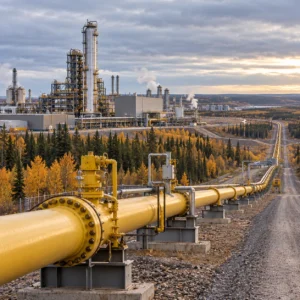
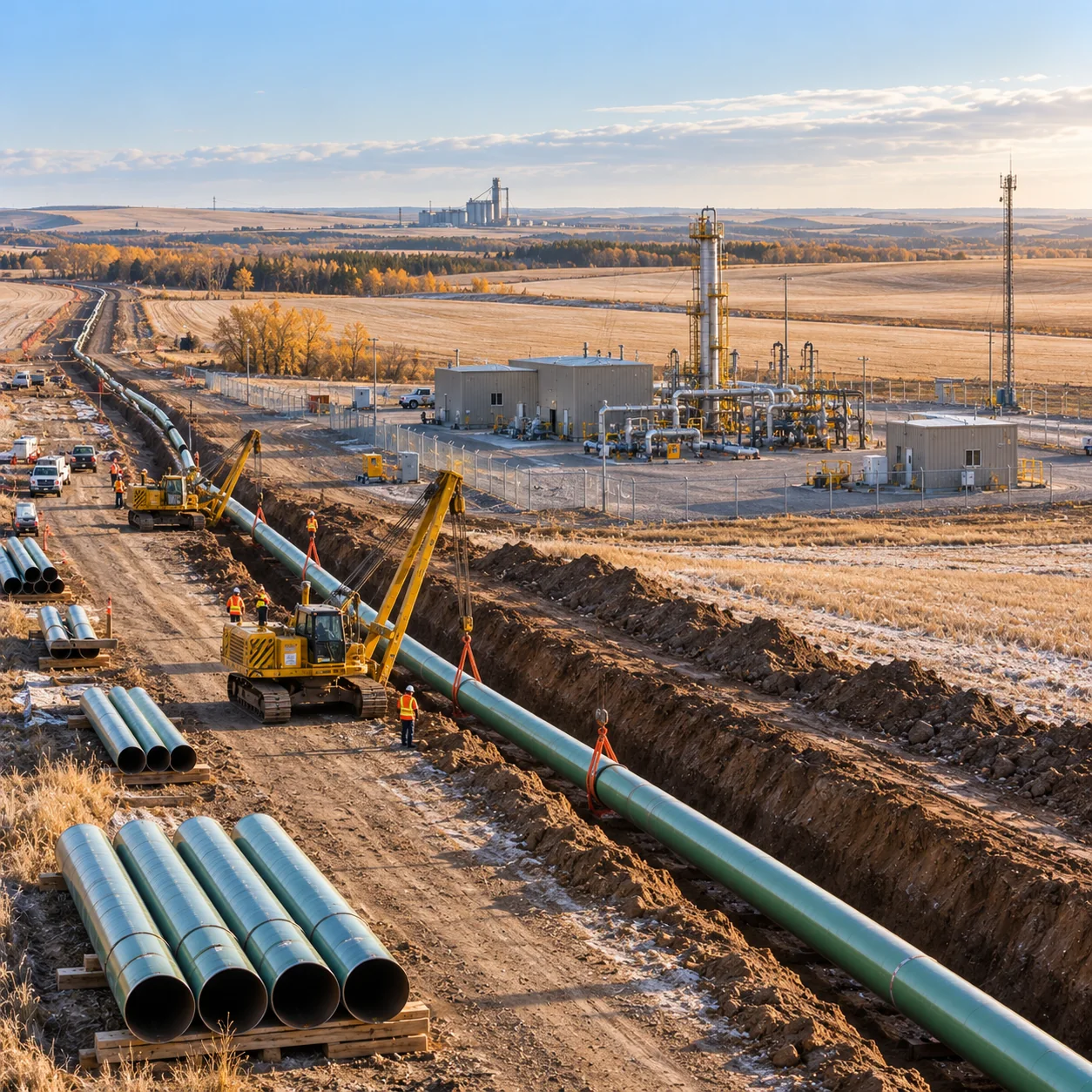
The engineering is done. Now comes the steel.
On October 8, Calgary based Gas Liquids Engineering (GLE) said it had completed its detailed engineering scope for Enhance Energy’s Origins Carbon Capture and Storage Hub near Clive, Alberta. The work covers the Origins CO₂ pipeline and the associated facilities that connect existing transportation infrastructure to the new sequestration hub.
It is a quieter announcement than a ribbon cutting, but it marks the point where a design becomes a build. Origins is expected to be the largest carbon capture and storage project in Canada, and the finish of detailed engineering means the hub is now being built to a completed design rather than a provisional one.
What the Engineering Scope Actually Covered
According to GLE, the scope spanned pipeline hydraulics, process and mechanical design, civil and structural engineering, electrical and instrumentation systems, controls and telecommunications, pipeline integrity, safety systems and construction requirements.
That list describes most of what determines whether a CO₂ system performs once it is switched on. Hydraulics set how dense phase CO₂ moves through the line. Integrity and safety design govern how the asset is monitored and protected for decades. Controls and telecommunications decide how operators see and manage flows between sources and the injection site.
Stuart MacKenzie, president and chief executive of GLE, called it “an important milestone for both CCS in Alberta and GLE.”
GLE says construction of Origins is underway and the project is expected to enter service in early 2027.
A Hub Designed to Plug Into Existing Infrastructure
Origins was not designed as a standalone project. Federal and provincial officials joined Enhance Energy on September 9 to start construction, and Natural Resources Canada says the hub is designed to initially store up to 1.5 million tonnes of CO₂ a year, with operations scheduled to begin in January 2027.
The Red Deer Advocate reports that the hub has potential to expand to as much as 20 million tonnes a year. Its first CO₂ sources are the Northwest Redwater Sturgeon Refinery and the Nutrien Redwater facility in Alberta’s Industrial Heartland.
The new pipeline engineered by GLE ties into the Alberta Carbon Trunk Line, a 240 kilometre system that opened in 2020 and runs between the Industrial Heartland and the Clive area. Natural Resources Canada describes the trunk line as one of the largest CO₂ transportation systems in the world.
That is the commercial logic of Origins. The expensive backbone already exists. The hub adds storage capacity at the end of it.
Why Storage Capacity Is the Real Constraint
Capture technology often draws the headlines, but industrial emitters cannot commit to capture without somewhere to send the CO₂. Every new tonne of permitted, operating storage changes the calculation for refiners, fertilizer producers, petrochemical plants, cement makers and power generators deciding whether to invest.
Natural Resources Canada says Origins will initially serve facilities in the Industrial Heartland and could later support oil and gas, petrochemicals, cement and power generation. Those are exactly the sectors where emissions are hardest to cut by other means.
Enhance Energy also brings an operating record. Its existing Clive area operation has stored more than 9 million tonnes of CO₂ since 2020, according to the federal government. Experience with injection, monitoring and reservoir behaviour at the same location reduces uncertainty for the next phase.
For emitters weighing a connection, the questions are now practical:
- How much hub capacity is available, and when
- What connection to the trunk line will cost
- How measurement and monitoring obligations are shared
- How the federal CCUS investment tax credit applies to capture equipment
- How long term storage liability is handled
Policy Alignment Is Giving Projects a Clearer Runway
Origins sits under the Canada and Alberta memorandum of understanding, and the federal Carbon Capture, Utilization and Storage Investment Tax Credit is intended to encourage investment across capture, transport and storage.
Officials on both sides have framed the hub as proof that growth and emissions goals can move together. “We don’t have to choose between our economy and our climate ambition. We can have both,” federal Energy and Natural Resources Minister Tim Hodgson said at the September groundbreaking, as reported by the Red Deer Advocate. Alberta Energy and Minerals Minister Brian Jean said “Alberta is a global leader in carbon capture and storage technology,” pointing to the province’s geology and expertise.
That alignment matters for engineering and construction firms as much as for operators. A visible pipeline of hubs gives Alberta’s service sector the confidence to build specialised CO₂ capability that can be reused from project to project.
The Next Milestone Is First Injection
With detailed engineering complete and construction underway, attention turns to commissioning and first CO₂ into the new reservoir in early 2027. Delivering on that schedule would give Canada a large operating storage hub connected to an established transport backbone, built around existing industrial sources.
It would also give developers of other Canadian hubs a current reference case for cost, schedule and performance.
Is the design ready?
Is the capacity ready for customers?
The first question now has an answer. The second will be answered in the field at Clive.