Canada has the projects. What it needs now is the capital to build them.
That is the central finding of Tracking the Tonnes 2026, the annual progress report from Carbon Removal Canada. The report counts 38 carbon removal projects in development, representing nearly 12 million tonnes of planned annual capacity and an estimated C$9 billion in investment, sitting behind a base of 16 operating projects across six provinces.
Those operating projects can remove 98,250 tonnes of CO₂ a year, roughly triple the capacity Canada had in 2023. The report sets the next milestone at two million tonnes of annual removal capacity by 2030, and estimates the cost of closing the gap at about C$2.2 billion.
Set against the scale of capital now moving through Canadian infrastructure, that number is smaller than it looks.
Capacity Under Construction Has More Than Tripled
The clearest sign of momentum sits in the construction column. According to the report, capacity under construction rose from 7,650 tonnes a year in 2025 to 27,500 tonnes a year in 2026, spread across one project in Ontario and one in Saskatchewan.
Once those two projects come online, expected by the end of 2027, Canada’s operating removal capacity grows by nearly 30%.
Behind them, planned and announced capacity climbed from about 10.9 million tonnes a year in 2025 to about 11.7 million tonnes a year in 2026. Alberta accounts for the largest share, with nine planned projects totalling roughly 6.5 million tonnes a year. Quebec follows with eight projects and about 2.8 million tonnes, and a single planned project in Newfoundland and Labrador is sized at one million tonnes a year.
Figures in the report reflect publicly disclosed projects, deals and grants as of November 1, 2026.
A National Sector Built on Regional Strengths
Carbon removal in Canada is not concentrated in one province or one method. Ontario’s two operating projects account for 41,000 tonnes a year, Quebec’s four account for 24,000 tonnes and Nova Scotia’s four account for 21,200 tonnes. Alberta and Saskatchewan each have two operating projects, with storage geology that supports much larger planned volumes.
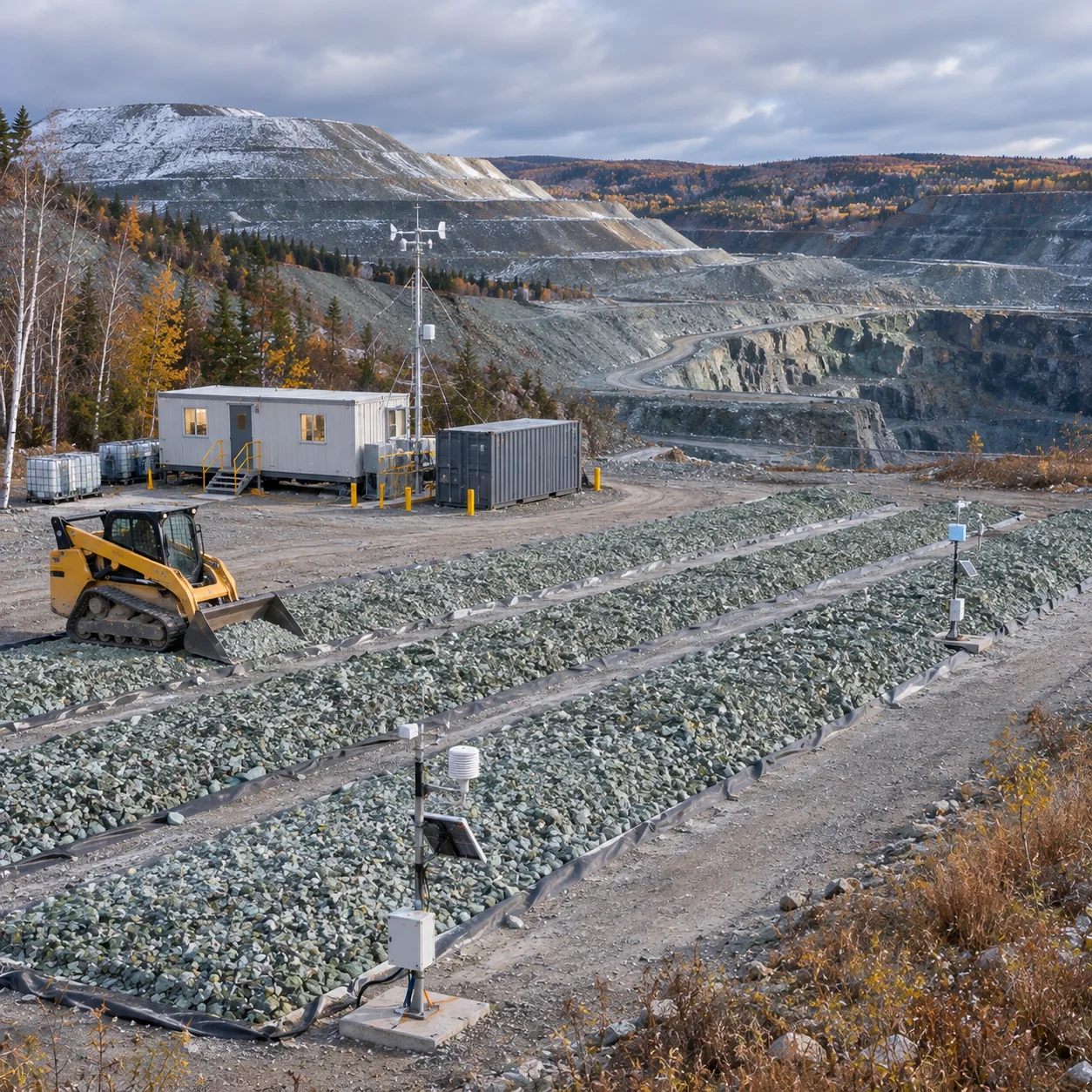
The report highlights a planned bioenergy with carbon capture and storage project at the Hinton Pulp Mill in Alberta as one example of removal built into an existing industrial operation. In Quebec, Carbon Removal Canada, Frontier Climate and DuGrisAuVert have launched the Quebec Surficial Mineralization Hub at a legacy asbestos mine in Thetford Mines, a site the partners say holds more than 400 million tonnes of carbon removal potential. The hub gives developers and researchers a permitted site, feedstock and shared equipment to deploy faster and at lower cost.
That model matters.
As Na’im Merchant, co-founder and executive director of Carbon Removal Canada, puts it in the report: “Carbon removal in Canada can be built into the industries the economy already depends on, from forestry and mining to steel, agriculture and energy.” For a mine, mill or plant selling into markets that price embedded carbon, removal can mean a cleaner product and a second revenue stream.
C$2.2 Billion Is a Small Slice of a Large Capital Pool
The report frames the funding requirement against a C$500 billion commitment by major Canadian financial institutions to critical sectors. The C$2.2 billion needed to add 1.9 million tonnes of capacity by 2030 amounts to less than half a percent of that total.
The harder problem is the shape of the money, not the size. Thirteen of the 15 equity deals in Canadian carbon removal since 2024 closed at or before Series A, according to the report. Non-dilutive grant funding rose to C$37.8 million across 17 grants in 2026, up from C$31.8 million in 2025, which has kept early-stage developers moving.
What is thin is capital for the demonstration stage, where projects are too large for venture funding but not yet proven enough for conventional project finance. That middle stage is also where the cost per tonne comes down.
Ottawa and the Provinces Have Laid the First Layer
Federal policy has moved in the right direction. The report notes that Ottawa launched one of the world’s first Requests for Standing Offers to procure permanent carbon removal, joined Canadian businesses in the Advance Carbon Removal Coalition, and announced in September 2026 that it is developing a framework under Article 6 of the Paris Agreement that could let Canadian projects sell credits into international carbon markets.
Among the provinces, Alberta earned the highest grade, BB+, for regulatory readiness and investment tax credits that stack on federal incentives. Internationally, Carbon Removal Canada places Canada ahead of the United States on policy stability, while noting that the European Union, Germany and the United Kingdom are building removal directly into their carbon markets.
Public support gives policymakers room to act. In a survey of 2,036 Canadian adults conducted in August 2026, 60% strongly or somewhat supported using carbon removal technologies to address climate change and create new economic opportunities.
Where the Next Wave of Demand Comes From
The report’s recommendations focus on turning a strong project list into steel in the ground. The priorities it sets out include:
- Including carbon removal in Article 6 frameworks so Canadian tonnes can reach international buyers
- Adding removal to the Clean Fuel Regulations and other compliance markets
- Funding demonstration projects through Natural Resources Canada’s Energy Innovation Program
- Broadening the CCUS investment tax credit to cover pathways such as surficial mineralization
- Building the federal C$10 million standing offer into a multi-year purchasing commitment that grows each year
Carbon Removal Canada estimates that about 20 Canadian companies could begin building demonstration projects in 2027 with the right support. For developers, that is the near-term opportunity. For investors and industrial hosts, it is an early look at which technologies will reach commercial scale first.
The Next Two Million Tonnes Will Be Built Project by Project
Canada’s carbon removal sector has its geology, its feedstocks, its storage rules in several provinces and a pipeline worth roughly C$9 billion. The pieces that remain are long-term buyers and demonstration capital.
Both are policy and finance decisions, and both are within reach.
The tonnes are already on the drawing board. The task now is to move them into construction.