Canada’s next carbon removal project may not need a well, a pipeline or a capture plant.
It may need a river, a quarry and a few trucks a day.
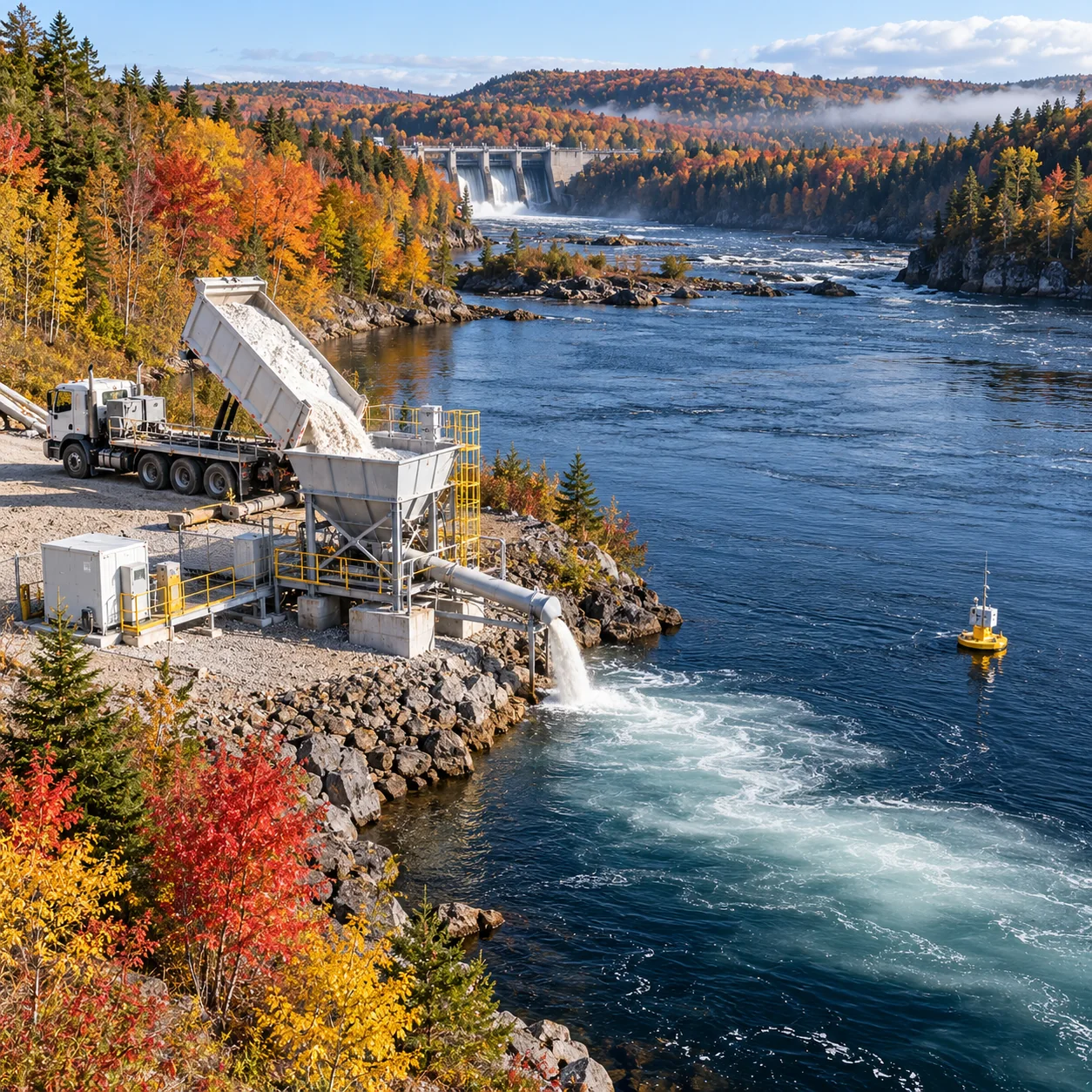
Nova Scotia based CarbonRun presented its plan to add powdered limestone to Quebec’s Saint-Maurice River at a public information session in Shawinigan on October 20, 2026, according to Le Nouvelliste. The company says the project could remove up to 10,000 tonnes of CO2 a year by raising the river’s alkalinity so that it holds more dissolved carbon. It would be CarbonRun’s first project in Quebec, after two completed projects in Nova Scotia and a temporary one in Sweden.
The proposal is small next to Alberta’s storage hubs. Its significance lies elsewhere. It brings a different kind of carbon removal into Canada’s development pipeline, one that relies on water chemistry and measurement rather than compression and injection.
How a River Becomes a Carbon Sink
River liming is an old practice with a new purpose. Crushed limestone added to an acidified river reacts with carbon from the air and surrounding land to form bicarbonate, which travels downstream to the ocean for long term storage. Frontier, the carbon removal buyers’ coalition, describes the method this way, and notes that CarbonRun found liming also boosts a river’s natural ability to draw CO2 from the air.
The Saint-Maurice fits the profile. The project description cited by Le Nouvelliste puts the river’s average pH at about 6.1, slightly below the 6.5 to 9 range recommended by Canadian and Quebec water quality guidelines. It also says low dissolved calcium leaves aquatic life more vulnerable to industrial pressures.
That gives the project two outputs: carbon removal and a less acidic river.
The Shawinigan Plan in Numbers
The engineering is deliberately modest. According to Le Nouvelliste, the key elements are:
- Up to 45,000 tonnes of limestone powder a year
- A dosing station near the Bauval quarry in the Grand-Mère sector of Shawinigan, downstream of the Rocher de Grand-Mère dam
- Locally sourced limestone, with agreements in principle reportedly reached with the quarry
- Two to six truckloads a day, adjusted to acidity and water levels measured daily
- Water quality data from three monitoring sites between the Grand-Mère dam and the river’s mouth at Trois-Rivières
- Operations possibly starting in late 2027, once all authorizations are obtained
CarbonRun also plans to open an office at the Centre d’entrepreneuriat Alphonse-Desjardins in Shawinigan, and its representatives told the newspaper the company is considering a similar project on the Batiscan River. On its website, the project carries the name Tapiskwan sipi/Rivière Saint-Maurice.
A Market Model That Asks Nothing of the Treasury
The financing story stands out in a Canadian CCUS sector that leans heavily on tax credits and government contracts.
CarbonRun sells carbon removal credits to private buyers on a voluntary basis and says the Saint-Maurice project requires no public funds, Le Nouvelliste reports. Its major client is the Frontier coalition, which supplies credits to technology companies including Google, Meta and Shopify. In 2024, Frontier buyers agreed to pay CarbonRun $25.4 million for 55,442 tons of CO2 removal delivered between 2025 and 2029, starting in Nova Scotia.
That deal shows corporate buyers are willing to commit real money to river based removal before projects reach full scale. For a sector that still debates who pays for carbon management, a privately funded pathway is a useful proof point.
Measurement Will Decide How Far This Scales
The method’s credibility rests on data. Frontier says CarbonRun measures water chemistry upstream and downstream of each treatment point, which allows CO2 removal to be quantified directly rather than inferred from models. Stripe has also funded a $1 million research grant to study liming in pH neutral rivers, a step that could widen the range of suitable waterways.
Local stakeholders are asking the right questions. Bassin versant Saint-Maurice, the regional watershed organization, has raised four sets of issues: effects on the ecosystem and aquatic species, the project’s net carbon balance and the reliability of its measurements, how offsetting fits with cutting emissions at the source, and how credits will be generated, verified and assigned. Its general director, Stéphanie Chabrun, says the group is neither for nor against the project at this stage and can draw on a network of 40 watershed organizations to review the file.
Co-founder Eddie Halfyard, who spent about 20 years with the Nova Scotia Salmon Association where the technique was first tested to restore acidified rivers, points to roughly 50 years of studies in Sweden and Norway that show when liming produces positive results and when it carries risk.
That is the right foundation for a review.
What Quebec’s Review Could Mean for Canadian Carbon Removal
Canada’s carbon management debate usually centres on large point source capture: oil sands, cement, fertilizer and power. Those projects remain essential. Carbon removal, however, is a separate market with its own buyers, verification rules and project types, and Canada has the geology, water resources and research base to compete in all of them.
Projects like the Saint-Maurice plan matter for three reasons. They are small enough to build quickly. They rely on local materials and local monitoring. And they generate verified tonnes that corporate buyers already want.
The Quebec review process will also set an early benchmark for how provincial and federal regulators assess aquatic carbon removal. A clear, evidence based approval path would give developers on other acidified rivers in Eastern Canada a template to follow.
Carbon removal will not come from one technology. Some of it may simply flow downstream.